
Secretary-General of the Supreme Council of Antiquities inspects the site and stresses the importance of scientific study and publication
The Egyptian archaeological mission working at Dra Abu el-Naga, on Luxor’s West Bank, has uncovered three rock-cut tombs dating to the New Kingdom, during its current excavation season. This important discovery adds to the growing documentation of elite burials in the Theban necropolis.
A National Achievement in Archaeology and Heritage
Mr. Sherif Fathy, Minister of Tourism and Antiquities, described the discovery as a scientific and archaeological accomplishment that enhances Egypt’s standing on the global map of cultural tourism. He emphasized that these newly discovered tombs will significantly contribute to attracting more visitors, especially cultural tourism enthusiasts, due to their distinctive civilizational and human value.
He further stressed that the discovery, achieved by an entirely Egyptian team, reflects the exceptional capabilities of Egyptian archaeologists and their ability to deliver discoveries of international importance.
Identifying the Tomb Owners through Inscriptions


During a brief visit to Luxor, Dr. Mohamed Ismail Khalid, Secretary-General of the Supreme Council of Antiquities, inspected the site and confirmed that all three tombs date to the New Kingdom. The names and titles of the tombs’ owners were identified through inscriptions inside the tombs. Dr. Khalid noted that the mission will continue cleaning and studying the remaining inscriptions to deepen knowledge about the tombs’ owners, with the aim of scientific study and publication.
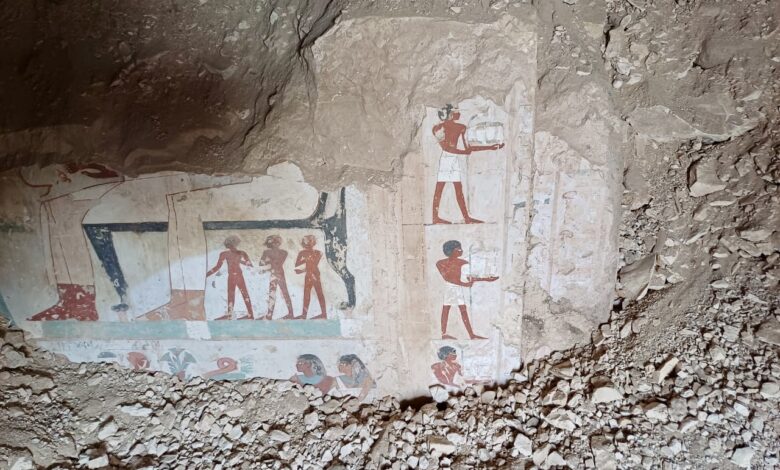
Mr. Mohamed Abdel-Badie, Head of the Egyptian Antiquities Sector at the Supreme Council of Antiquities, explained that one of the tombs belongs to a man named “Amun-em-Ipetâ€, who lived during the Ramesside Period and worked in the temple or estate of Amun. While most of the decorative scenes have been destroyed, the surviving elements depict offering rituals, a funerary furniture procession, and a banquet scene.
The second and third tombs date to the 18th Dynasty:
• One belonged to “Bakiâ€, who held the position of Supervisor of the Granary.
• The third belonged to a man named “Sâ€, who was Supervisor of the Temple of Amun in the Oases, Mayor of the Northern Oases, and a scribe.
Architectural Layout of the Tombs
Dr. Abdel-Ghaffar Wagdy, Director-General of Antiquities in Luxor and head of the mission, provided details on the architecture of the three tombs:
• The tomb of Amun-em-Ipet features a small forecourt, followed by an entrance, then a square hall ending in a niche. The niche’s western wall was broken during a later reuse of the tomb to convert the space into an additional hall.
• The tomb of Baki consists of a long corridor-like courtyard, leading to a second courtyard and then the main entrance. This opens into a transverse hall, followed by a longitudinal hall ending in an unfinished shrine that contains a burial shaft.
• The tomb of “S†begins with a small courtyard containing a burial shaft, followed by the main entrance, which leads into a transverse hall and then an unfinished longitudinal chamber.
Ongoing Scientific Documentation and Analysis
Dr. Khalid stressed the importance of continuing excavation, cleaning, and detailed epigraphic work to allow for scientific analysis and formal publication. The discovery adds new insight into the administrative and religious roles of New Kingdom officials, while also enriching our understanding of the architectural evolution of private tombs in the Theban necropolis.
#Egypt #Egyptology #LuxorTimes #Luxor #Archaeology