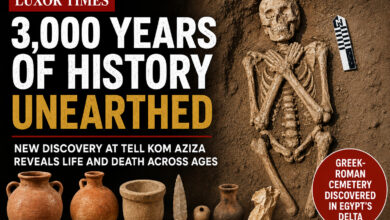


The Egyptian Italian Archaeological Mission has recently discovered auko of industrial workshops of the Late Period and Ptolemaic period, as well as a cemetery of the Roman period with various burial styles in the Egyptian Western Nile Delta.

The findings resulted from excavations being undertaken at Kom el Ahmar and Kom Wasit in Beheira Governorate by a joint investigation project conducted by the Supreme Council of Antiquities and the University of Padua.
According to Secretary-General of the Supreme Council of Antiquities, Dr Mohamed Ismail Khaled, “These discoveries are a valuable addition to what is known about patterns of daily life and human activity in the western Delta and the landlocked areas around Alexandria.â€


The Secretary-General went on to say, “They will allow us to learn more about patterns of settlement, industry, and burial rituals in the Late Period, the Roman period, and the early Islamic period, and will also reveal information about communication patterns in the region.â€
Late Period and Early Ptolemaic Industrial Activity


This was according to Mohamed Abdel Badie, the Head of the Egyptian Antiquities Sector, who reported that the location of the industrial area was found to be enclosed by a large building that had at least six rooms. Two of the rooms had fish processing facilities as indicated by the discovery of 9,700 bones of fish.


Details of the remaining rooms reveal the processing of stone, metal tools, and faience amulets. Unfinished statuettes of limestone were discovered along with objects that were works-in-progress. This showed that the work was carried out on the site. There were imports of amphorae containers and shards of Greek vessels that enabled the dating of the workshops to the fifth century BCE.

Roman Cemetery with Various Burial Rites
Excavation work also uncovered an area of a Roman era cemetery with graves belonging to three principal funerary traditions. These traditions include burial in a grave with direct interment in the ground, internment within ceramic coffins, and child burials within large amphora graves.

Italian Mission head Dr. Cristina Mondin said, “Currently, bioarchaeological analyses of the skeletons are being carried out in order to establish age, gender, diet, and state of health.â€
There were 23 skeletons found in this cemetery, of both males and females, including youths, adolescents, and adults.
Preliminary evidence suggests that these people lived under fairly good conditions, without any signs of serious disease or physical violence.

Artefacts Transferred for Study

These are some of the remarkable discoveries which include several complete amphorae, as well as a pair of earrings made of gold which belonged to a young woman. These artifacts were moved to the Egyptian Museum in Cairo.