
Significant new archaeological discoveries have been announced in Luxor, where Egyptian teams working under the Supreme Council of Antiquities have uncovered a set of child-sized wooden coffins at Al-Asasif necropolis on the West Bank, as well as a large mudbrick enclosure and a series of ancient industrial installations at Nagaa Abu Asba, located on the East Bank just south of Karnak Temple.
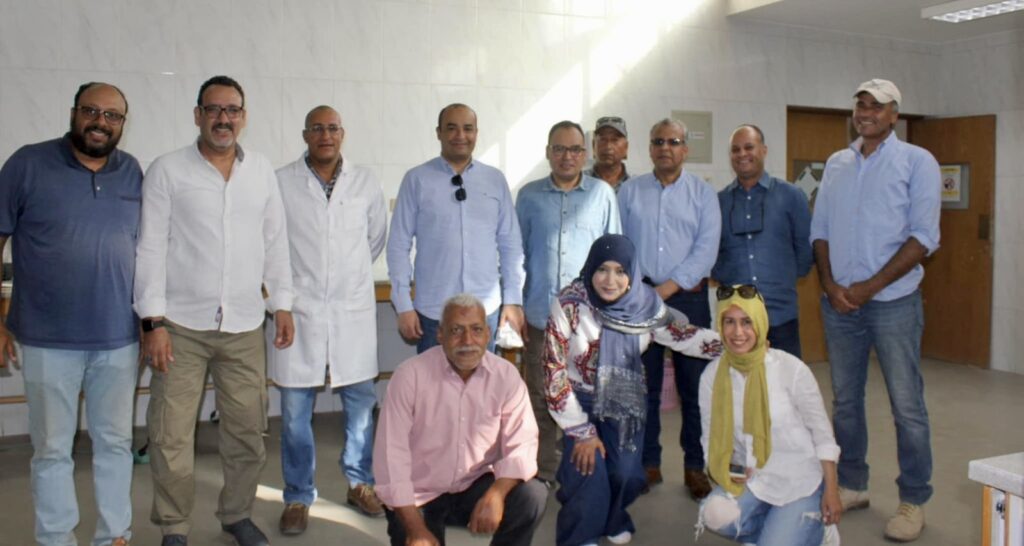
The announcement was made during an official visit by Dr. Mohamed Ismail Khaled, Secretary-General of the Supreme Council of Antiquities, who toured both sites to inspect ongoing fieldwork by Egyptian-led excavations.
Findings at Al-Asasif
At the Al-Asasif necropolis, archaeologists uncovered a cluster of small wooden coffins believed to be child burials. Most are in an advanced state of decay and notably lack inscriptions or decorative elements, making their dating challenging at this stage.
“These coffins will undergo thorough examination by specialists in human osteology and wooden coffin preservation,†Dr. Khaled stated. “This will help us determine their chronological context, while the study of the remains will offer insight into the age, sex, and potential causes of death—data that will deepen our understanding of the burial patterns in this part of the Theban necropolis.â€
Other discoveries at the site include a series of ostraca—inscribed pottery and limestone fragments—along with two partially broken conical clay seals, one bearing the title “Supervisor of the House, Khonsu.†Excavators also documented a vertical shaft containing blue faience ushabti figurines and a plaster-coated column at the center of a chamber. The column and surrounding walls are currently undecorated and uninscribed.


A 21st Dynasty Discovery at Nagaa Abu Asba
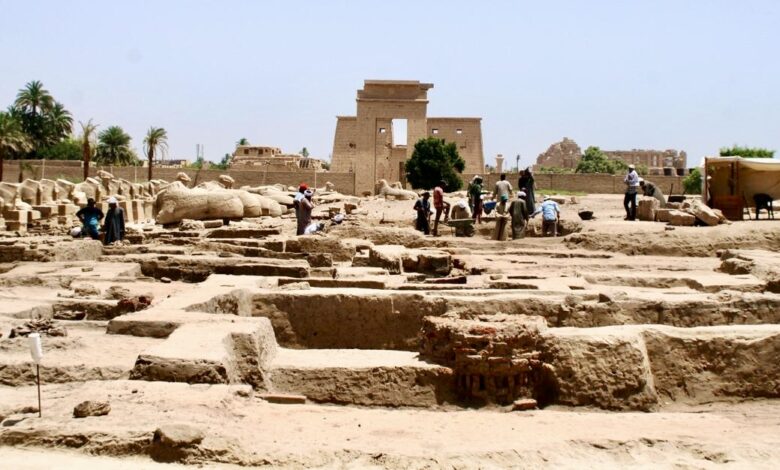
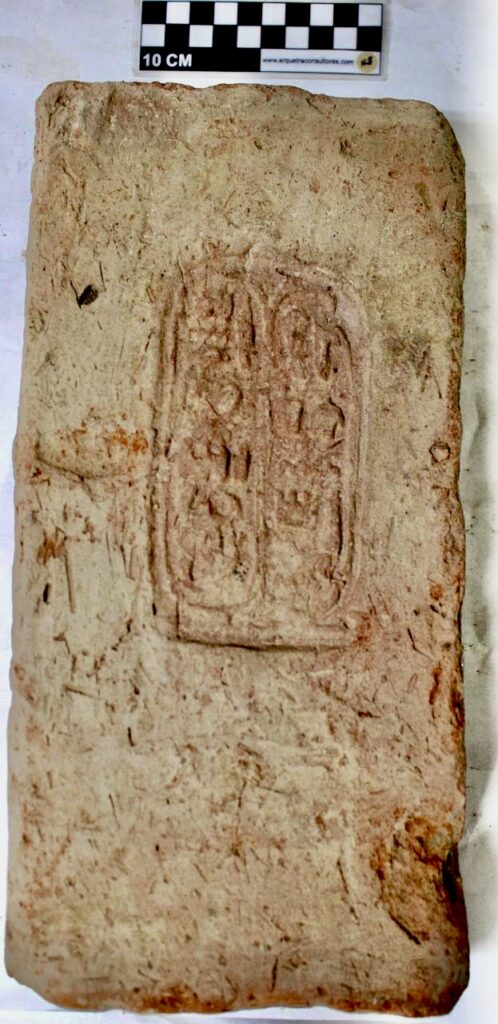
Across the river on Luxor’s East Bank, just south of the Karnak temple complex, a second Egyptian mission has revealed an impressive mudbrick enclosure wall dating to the 21st Dynasty, during the reign of King Menkheperre (r. ca. 1045–992 BCE). Each brick is stamped with the king’s name and that of his wife, providing a rare combination of royal titulary on construction materials.
The enclosure, thought to have served an industrial or administrative function, contains a sandstone gateway, traces of multiple workshops, and kilns used for bronze casting. Within this complex, archaeologists discovered bronze Osirian statuettes in varying sizes, alongside a collection of coins and protective amulets.
Among the most notable finds was a large-scale beer-brewing installation—evidence of the site’s long-standing industrial role, possibly supporting religious or state-sponsored enterprises.
“These findings indicate that the area was a hub of economic activity, likely serving the adjacent Karnak complex during different periods of its occupation,†said Dr. Abdel Ghafar Wagdy, director of the Nagaa Abu Asba mission. “The size and quality of the installations suggest an organized and state-managed production center, with ritual and domestic applications.â€
Context and Ongoing Research
Mohamed Abdel-Badie, head of the Central Department of Antiquities for Upper Egypt, emphasized that these discoveries contribute to a more accurate view of Theban society—one that integrates funerary, economic, and administrative functions on both banks of the Nile.
While the West Bank continues to yield evidence of elite and non-elite burials, the East Bank sites are increasingly offering insight into the infrastructure that sustained Thebes as a religious and political capital.
Future seasons will focus on detailed conservation, epigraphic documentation, and laboratory analysis of the organic and material remains. These will help contextualize the finds and shed further light on the roles of children, craft industries, and urban planning in ancient Luxor.
#Egypt #Luxor #Egyptology #Archaeology #LuxorTimes