
Remains of ‘Imet’ City Uncovered in Eastern Nile Delta
A new chapter in the archaeology of the Nile Delta is unfolding with the rediscovery of the ancient city of Imet at Tell el-Fara’in (also known as Tell el-Nabasha), where a joint Egyptian-British team has unearthed dense mudbrick architecture, multistory residential towers, and remnants of a processional route linked to the cult of the cobra goddess Wadjet.

Led by Dr. Nicky Nielsen of the University of Manchester, the team employed satellite imagery and remote sensing techniques—particularly high-resolution Landsat data—to identify concentrations of mudbrick prior to excavation. Their focus on the site’s eastern sector brought to light residential complexes dating to the early or mid-4th century BCE, a transformative time that spans the Late Period into the beginning of the Ptolemaic era.
Tower Houses and Daily Life in the Late Period Delta
Among the most compelling finds are the remains of so-called tower houses—multistory dwellings supported by exceptionally thick foundation walls, designed to accommodate expanding urban populations. These structures, rare in most of Egypt but characteristic of the Delta from the Late Period through Roman times, speak to a city both densely populated and architecturally ambitious.

“These buildings tell us that Imet was no minor settlement,†said Dr. Mohamed Ismail Khaled, Secretary-General of the Supreme Council of Antiquities. “This was a thriving urban centre with advanced infrastructure, capable of supporting large residential communities.â€


Additional mudbrick structures in the vicinity were identified as granaries and animal enclosures, suggesting that Imet was not only religiously significant but economically active, with integrated systems for food storage and livestock management.
Tracing Sacred Landscapes: The Temple of Wadjet
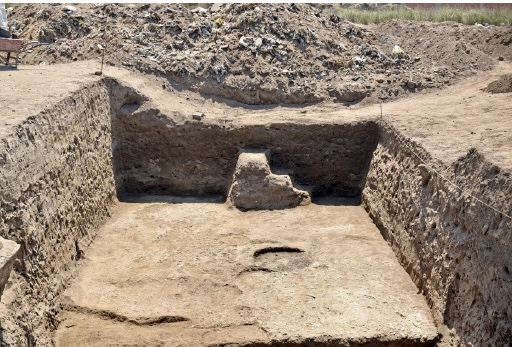
The western part of the tell yielded further surprises: a large limestone-paved floor and the remains of two massive mudbrick columns—likely once plaster-coated—were uncovered in what appears to have been a temple or ceremonial structure. These features are believed to lie atop a processional road that once connected a Late Period pylon with the temple of Wadjet, whose ruins still stand on the site’s western edge.
The route seems to have fallen into disuse by the mid-Ptolemaic period, a symbolic marker of shifting religious geographies in Egypt’s north.
The temple itself underwent several phases of reconstruction and reuse, including notable refurbishments under Ramesses II (1279–1213 BCE) and Amasis II (570–526 BCE). During the Persian (Achaemenid) occupation, the sanctuary may have been stripped for building materials—converted, quite literally, into a quarry.
Ritual Objects from a City of Gods and Guardians
Artifacts from the dig further underscore Imet’s spiritual significance. Among the discoveries:
• The upper half of a green faience ushabti, dated to the 26th Dynasty, finely modeled with detailed features.
• A limestone stela showing the god Horus standing triumphantly on two crocodiles while grasping serpents—a potent symbol of divine protection. Above him is a depiction of the dwarf god Bes, another guardian figure.
• A bronze sistrum, or ritual rattle, ornamented with twin heads of Hathor, goddess of music, fertility, and joy. The instrument likely dates to the closing decades of the Late Period.
“These ritual objects highlight the deep spiritual life of Imet’s inhabitants and the diversity of deities venerated here,†said Mohamed Abdel-Badie, Head of the Egyptian Antiquities Sector at the Ministry of Tourism and Antiquities.
A City at the Crossroads of Eras
The site of Imet—though modest today—is increasingly revealing its past stature as a major urban and religious center of Lower Egypt. Once part of a powerful Delta network, it played a central role during the New Kingdom and continued into the Late Period as a hub for cultic worship, domestic life, and regional commerce.
As Dr. Nielsen remarked: “Each season brings us closer to understanding the full historical and archaeological landscape of Imet. This latest discovery is not just a milestone—it’s a doorway to future investigations into a city that once stood at the heart of the Delta’s cultural identity.â€
With its blend of urban planning, ritual infrastructure, and architectural innovation, Imet is poised to become a cornerstone in the study of Late Period Delta cities. The dig season may be over, but the story is just beginning.

#Egypt #Egyptology #Archaeology #NileDelta