

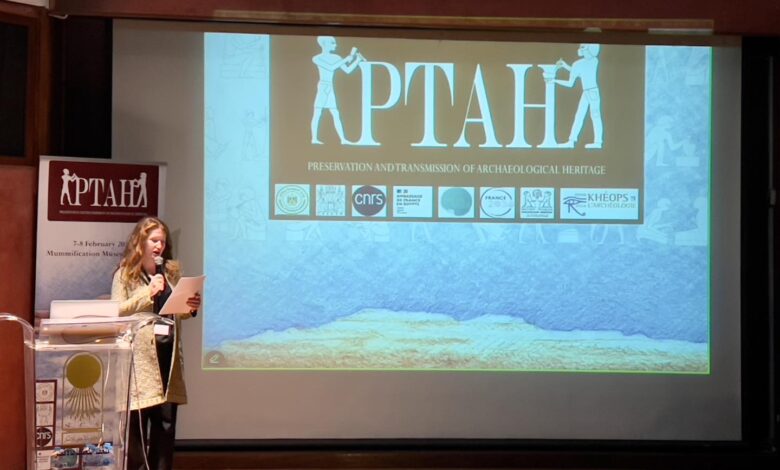
Following a dynamic opening day, the PTAH Symposium 2025 continued its sessions at the Mummification Museum in Luxor, delving deeper into key conservation projects across Egypt. Experts and researchers presented case studies highlighting both the challenges and advancements in preserving Egypt’s vast architectural and archaeological heritage.
Morning Session – Architectural Conservation and Restoration
Chaired by Manon Lefèvre
The day commenced with a presentation by Hiroko Kariya, who outlined the long-term conservation project of architectural fragments at Luxor Temple. Kariya’s work underscored the importance of safeguarding displaced or fragmentary remains, which often face environmental degradation and structural instability. The project employs both traditional conservation techniques and modern technologies to stabilize and document these fragments, ensuring their preservation for future study and potential reintegration into site displays.
Next, a prerecorded video presentation by Sophie Duberson focused on the restoration of the tomb of Padiamenopé (TT33). She provided valuable insight into the complex challenges posed by this vast tomb, one of the largest non-royal burial structures in Thebes. Duberson detailed the tomb’s delicate condition, the conservation strategies implemented, and the broader significance of TT33 in understanding Late Period funerary practices.
The morning session concluded with a discussion by Marianne Rochebeuf on the Pashedu limestone sarcophagus at Deir el-Medina. This case study explored the sarcophagus’s artistic and historical value.


Rochebeuf emphasized the role of scientific analysis in guiding restoration decisions.
Afternoon Session – Conservation Science and Digital Applications
Chaired by Dr. Laura Bontemps
Following a brief tea and coffee break, the second half of the day shifted focus to conservation science and digital methodologies.
A prerecorded presentation by Emilie Hubert and Philippe Bromblet examined the conservation state, cleaning tests evaluation, and pigment analysis of the mural paintings in TT33. Their research demonstrated how scientific approaches, including multispectral imaging and chemical analysis, are crucial in diagnosing deterioration patterns and guiding appropriate restoration interventions.
The final presentation before the lunch break, delivered by Timothée Sassolas Sorrayet, explored the applications of photogrammetry in the Theban heritage context. Sorrayet showcased how photogrammetry—a digital imaging technique used to create precise 3D models—enhances documentation, site management, and conservation planning. His work highlighted recent applications in Karnak temple, offering a glimpse into how digital tools are transforming heritage preservation.
Looking Ahead
With two days of intensive discussions and presentations completed, the PTAH Symposium continues to provide a platform for conservation professionals to share their expertise and innovative solutions. As the conference progresses, attendees can anticipate further insights into cutting-edge restoration methodologies and interdisciplinary collaborations shaping the future of archaeological heritage preservation in Egypt.
Stay tuned for more updates from the PTAH Symposium 2025 in Luxor.
#Egypt#Luxor#Restoration#Egyptology#archaeologgy


