
As part of the Supreme Council of Antiquities’ continuous efforts to monitor and support archaeological projects across Egypt, Dr. Mohamed Ismail, Secretary-General of the Supreme Council of Antiquities, conducted an inspection tour in Luxor to review progress at two key sites: the restoration of the first pylon of the Ramesseum and the conservation works in the recently discovered tomb of King Thutmose II.
Restoration of the First Pylon at the Ramesseum
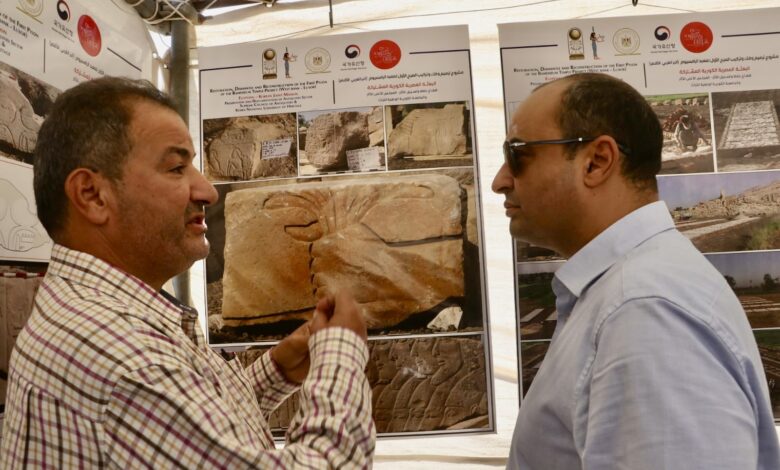
Dr. Mohamed Ismail’s tour began at the Ramesseum, the mortuary temple of King Ramesses II, where the Egyptian archaeological mission from the Department of Conservation and Documentation of Antiquities is working in collaboration with the Korea National University of Cultural Heritage. The project, funded by the Cultural Heritage Administration of the Republic of Korea, aims to reconstruct and restore the temple’s first pylon, much of which collapsed during the catastrophic earthquake of 27 BCE.
During the visit, Dr. Mohamed Ismail inspected the excavation areas around the temple, where teams are uncovering fallen blocks from the pylon buried for over two millennia. He reviewed the storage and conservation facilities where massive sandstone blocks are documented and prepared for reconstruction. Dr. Hesham El-Leithy, Head of the Department of Conservation and Documentation of Antiquities and director of the project on the Egyptian side, presented a detailed briefing on the project’s milestones since its launch in mid-2023, including digital documentation, 3D scanning of blocks, and site preparation for reconstruction.
Dr. Mohamed Ismail praised the progress achieved so far, emphasizing the importance of scientifically documenting and numbering every block to ensure the accurate reassembly of the pylon. He underscored that the project’s ultimate goal is to restore the pylon to its original appearance and reinstate it as the main entrance to the temple, replacing the northern gate currently used by visitors.
“This work is a crucial part of our mission to safeguard Egypt’s archaeological heritage and enhance the visitor experience at our sites and museums,†Dr. Mohamed Ismail said. “By restoring the original gateway, we will bring visitors closer to the temple’s appearance as Ramesses II intended.â€


Dr. El-Leithy added that the discovery of newly uncovered blocks not only aids in the restoration process but also provides valuable academic data for Egyptologists and architectural historians studying New Kingdom temple design and construction techniques.
The Ramesseum is one of Luxor’s most significant monuments, serving as a historical record of Ramesses II’s reign. Its walls are carved with detailed reliefs depicting the Battle of Kadesh and religious and funerary scenes, while its monumental statues and colonnades remain a striking example of New Kingdom royal architecture. The seated colossus of Ramesses II, once over 17 meters tall and weighing approximately 1,000 tons, remains one of the temple’s most iconic features.
Visit to the Tomb of Thutmose II
The tour also extended to the Western Wadis, where the Egyptian-British mission uncovered the long-lost tomb of King Thutmose II earlier this year, marking the final missing royal tomb of the 18th Dynasty to be located. Dr. Mohamed Ismail visited the tomb and its surrounding area, where excavation and documentation work is ongoing.
The British side of the mission is led by Dr. Piers Litherland, who serves as field director.  Among the discoveries was a foundation deposit containing three vessels made of pottery and alabaster, along with the skeletal remains of a young cow. An inscription on one of the alabaster jars bears the name of Queen Hatshepsut, indicating that she ordered the construction of the tomb for her brother and husband, King Thutmose II. The mission continues to explore the surrounding area in search of additional burials and associated structures.
Dr. Mohamed Ismail stressed the importance of completing the conservation work inside the tomb and continuing excavations in its vicinity to reveal more about the history of this secluded valley and the royal necropolis of the early 18th Dynasty.
Accompanying Officials
Dr. Mohamed Ismail was accompanied during the tour by Mohamed Abdel-Badie, Head of the Egyptian Antiquities Sector; Dr. Abdel-Ghaffar, Director-General of Luxor Antiquities; Dr. Bahaa Abdel-Gaber, Director-General of Qurna Antiquities; Jisoo Kim, the Korean project leader; and a team of inspectors, restorers, and members of the Egyptian, Korean, and Egyptian-British missions.
#Egypt#Egyptology#Archaeology#Luxor#LuxorTimes