
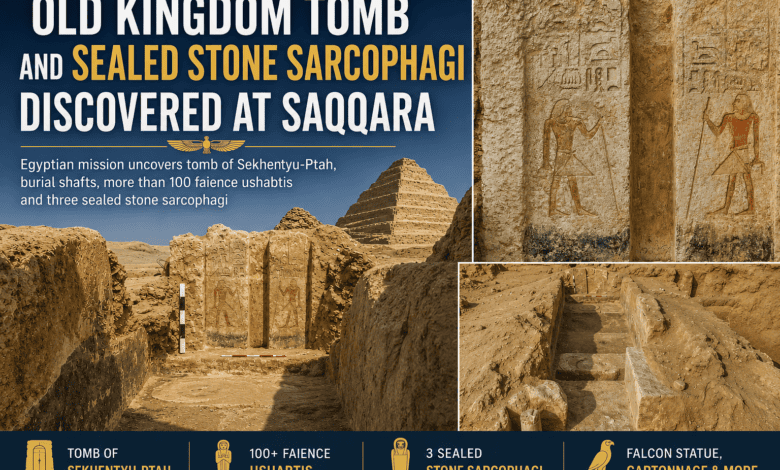
Egyptian archaeological mission uncovers the tomb of Sekhentyu-Ptah, an interconnected system of burial shafts, more than 100 faience ushabtis and three sealed stone sarcophagi in the Bubasteion necropolis.
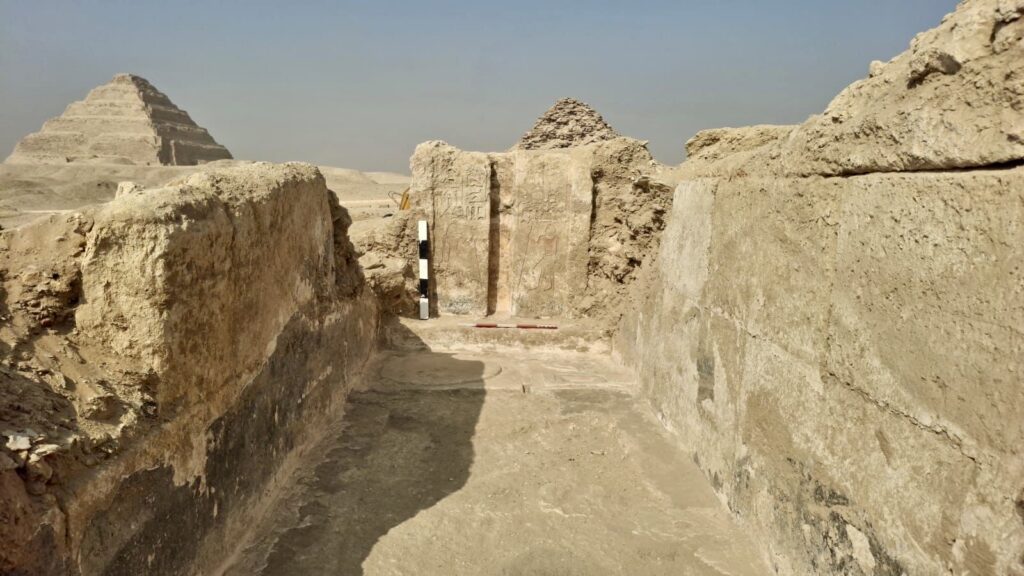
An Egyptian archaeological mission working at the Bubasteion necropolis in Saqqara has announced the results of its first excavation season in Sector A, west of the Bubasteion, revealing an Old Kingdom tomb alongside an extensive system of burial shafts containing human burials and a significant collection of funerary objects.
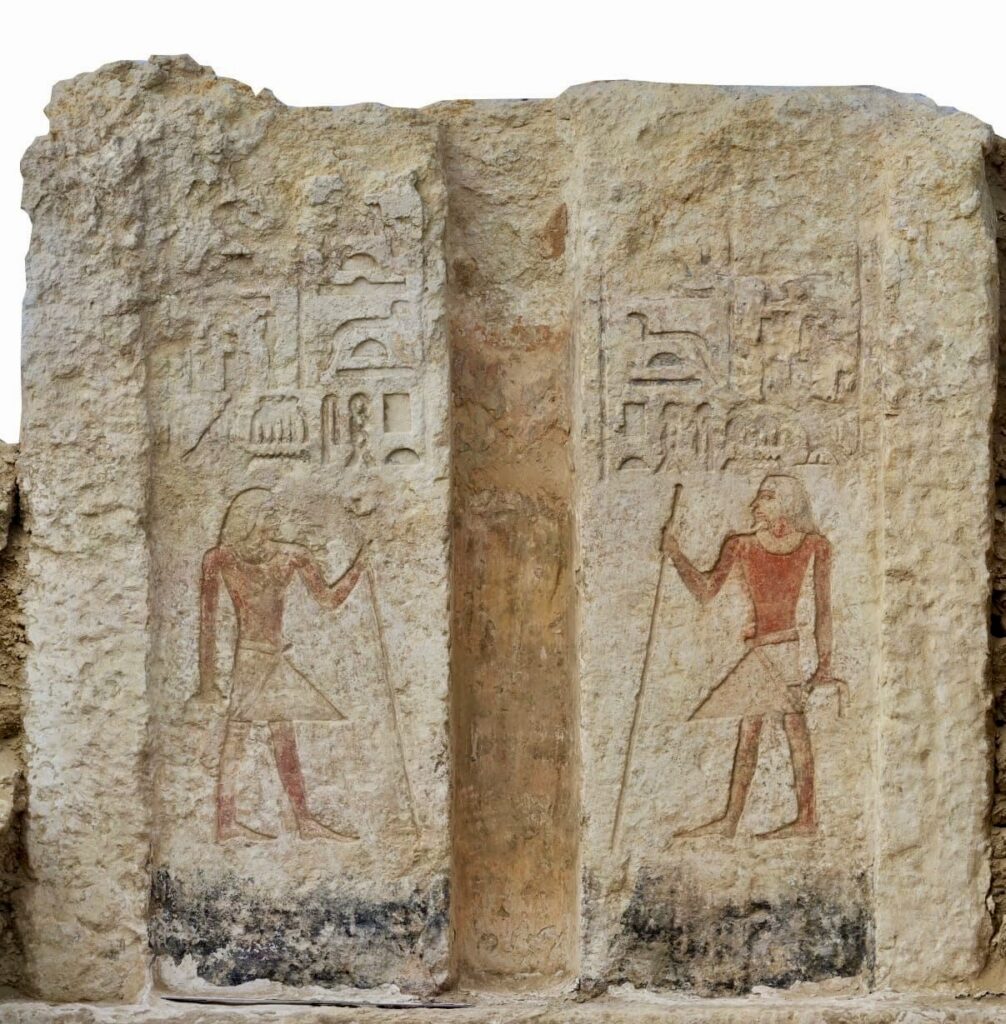
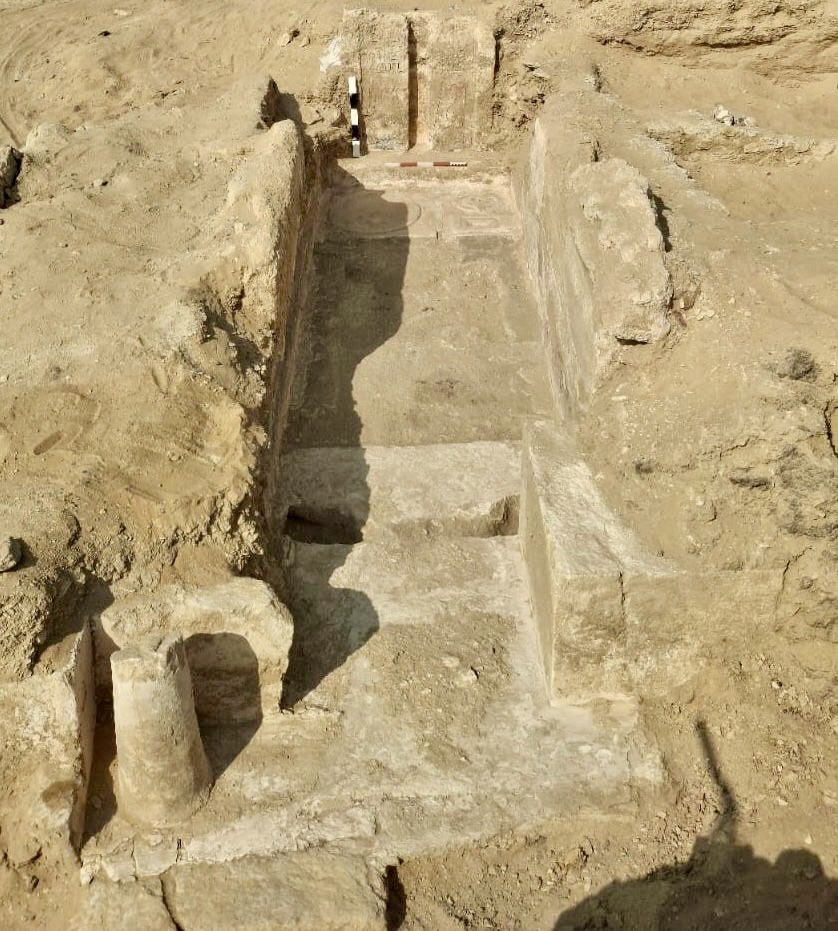
Among the most important discoveries is the Old Kingdom tomb of Sekhentyu-Ptah, whose surviving funerary chapel contains a false door still standing in its original position.
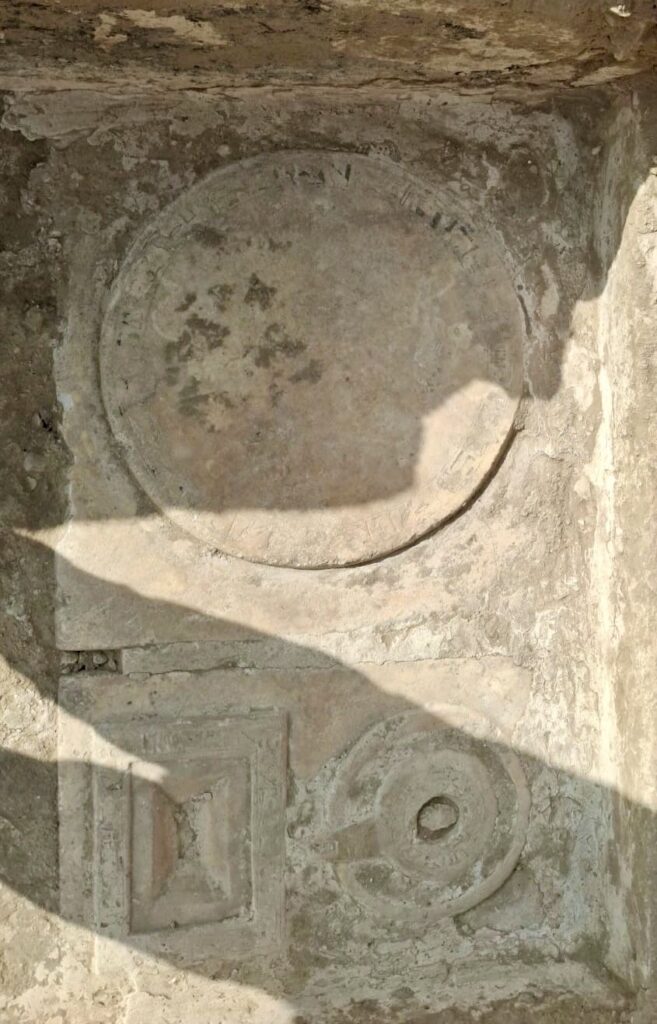
Directly in front of the false door, archaeologists discovered a complete assemblage of alabaster funerary ritual equipment. The group includes an offering table and offering disc, a purification basin, a ewer and a basin. The objects bear hieroglyphic inscriptions recording the tomb owner’s name and titles.
The discovery of the assemblage in its original archaeological context is particularly significant, providing evidence for funerary rituals and practices during the Old Kingdom.
The inscriptions preserved on the false door and funerary objects have allowed archaeologists to identify Sekhentyu-Ptah and reconstruct aspects of his career within the Old Kingdom administration.


His titles included Royal Chamberlain, Overseer of All the King’s Works, Overseer of Royal Documents, Keeper of the Secrets of Royal Commands, Priest of the goddess Maat and Overseer of Scribes. Together, the titles indicate the senior administrative position he occupied within the royal administration.
Burial Shafts Reveal Later Use of the Necropolis
Excavations also uncovered an interconnected system of burial shafts containing numerous human burials and substantial quantities of colourful funerary cartonnage.
More than 100 faience ushabti figurines were recovered, together with three stone sarcophagi discovered sealed in their original condition.
Other finds include a wooden figure in the form of a falcon, pottery vessels and a variety of archaeological objects.
The material provides important evidence for studying funerary practices and burial methods during the Late Period and demonstrates that this part of the Saqqara necropolis continued to be used and reused over successive periods of Egyptian history.
Preliminary investigations have also revealed evidence that some of the burial shafts were looted in antiquity. Openings cut between burial chambers appear to have been created by ancient tomb robbers.
Despite this disturbance, the surviving archaeological contexts and objects retain considerable scientific value and could help researchers reconstruct the internal organisation, architectural development and changing use of this section of the necropolis.
Egypt’s Minister of Tourism and Antiquities, Sherif Fathy, said the discovery highlights the funerary and historical importance of the Bubasteion necropolis and its continued use across different periods of Egyptian history. He described the results as an important contribution to understanding the development of the site.
Dr Hisham El-Leithy, Secretary-General of the Supreme Council of Antiquities, said the excavations were conducted through an integrated scientific programme incorporating careful excavation and stratigraphic recording, architectural, photographic and digital documentation, archaeological and linguistic studies, and comparative analysis.
According to Mohamed Abdel Badie, Head of the Egyptian Antiquities Sector, finding the complete funerary ritual assemblage in its original position inside Sekhentyu-Ptah’s chapel is particularly important because of the information it can provide about Old Kingdom funerary practices.
Qutb Fawzy, Head of the Central Administration for Cairo and Giza Antiquities, said the burial-shaft complex yielded the human remains, cartonnage, ushabtis, sealed stone sarcophagi and other archaeological material.
Dr Amr El-Tebbi, Director-General of the Saqqara Antiquities Area and head of the Egyptian mission, said the discoveries provide substantial material for investigating Late Period funerary rituals and burial practices, as well as tracing the successive phases during which the necropolis was reused.
The Egyptian mission will continue documenting, analysing and comparing the discoveries with material from other archaeological sites. The results are expected to be prepared for publication in specialised peer-reviewed academic journals.
Excavations will also continue at the site, where archaeologists believe there are promising indications that further structures and artefacts remain to be discovered.
The continuing work is expected to provide a more detailed picture of the long history of the Bubasteion necropolis and its development as one of Saqqara’s important multi-period archaeological areas.