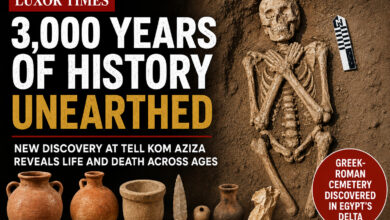

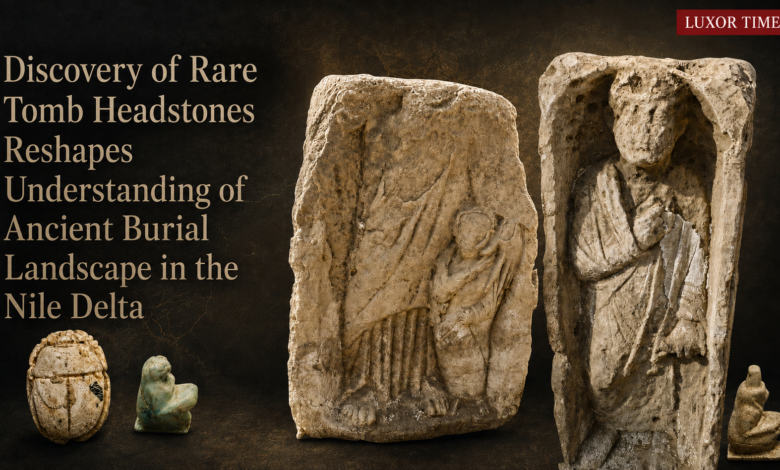
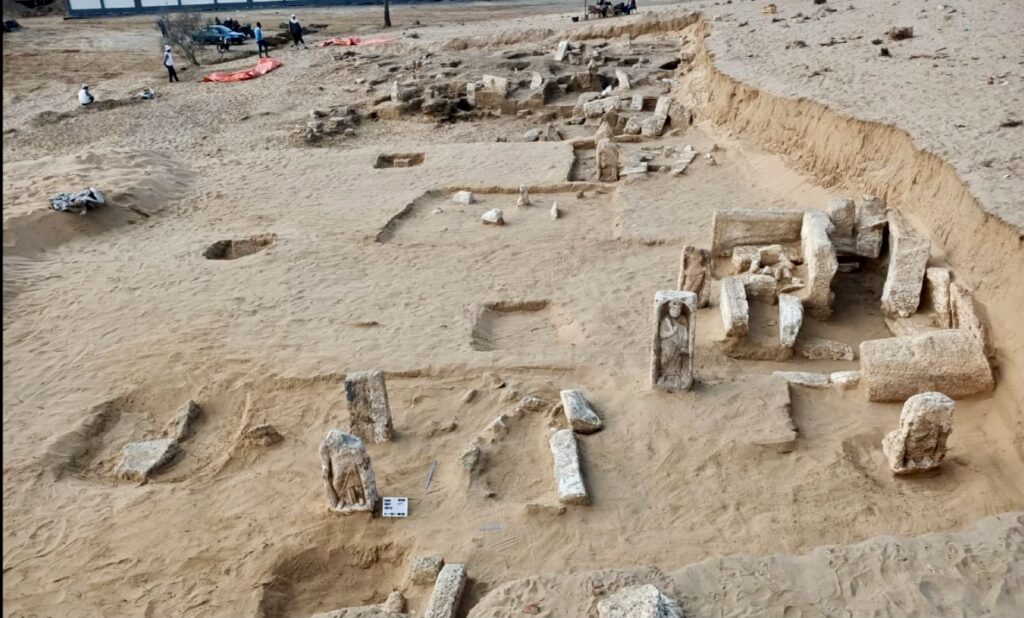
An Egyptian archaeological mission from the Supreme Council of Antiquities has uncovered a collection of rare tomb headstones, clay coffins, funerary amulets, and ritual objects at Tell El-Deir in Damietta Governorate during the current excavation season, confirming the site’s role as a major ancient funerary center in Egypt’s eastern Nile Delta.
Dr. Hisham El-Leithy, Secretary-General of the Supreme Council of Antiquities, said the Council continues to provide full support to the Egyptian mission in line with the directives of Minister of Tourism and Antiquities Sherif Fathy to facilitate the work of archaeological missions across Egypt.
El-Leithy said the discovery opens new horizons for understanding the development of ancient cemeteries in the Nile Delta, confirming that Tell El-Deir was not merely a burial site but a fully developed funerary center reflecting a distinct social, cultural, and religious identity. He added that the finds further enhance the archaeological significance of the site, which is considered one of the most important archaeological locations in the eastern Delta. Its rich archaeological layers have the potential to reshape scholars’ understanding of ancient settlement patterns, burial grounds, and the history of Damietta in antiquity.
Mohamed Abdel Badie, Head of the Egyptian Antiquities Sector at the Supreme Council of Antiquities, said the mission uncovered approximately 20 unique limestone tomb headstones, carefully carved in human form and decorated with religious symbols, including the griffin, Agathodaemon, and Isis Thermouthis. These iconographic elements reflect a notable interaction between ancient Egyptian religious traditions and Greco-Roman influences while also indicating the distinguished social status of those commemorated.
The mission also uncovered a large and varied collection of pottery incense burners, decorated oil lamps of different forms, anthropoid barrel-shaped clay coffins, and a number of funerary amulets. Together, these discoveries provide a more complete picture of the rituals and symbolic practices associated with burial across different periods.
According to the archaeological mission, the discoveries demonstrate that Tell El-Deir remained an active cultural and funerary landscape from the Late Period through the end of the Roman Period, making the site an exceptional archaeological record of the social, religious, and funerary transformations that took place in Egypt’s Nile Delta over many centuries.