
Egypt has successfully recovered four rare ancient artifacts from the United States, including a granite sphinx head that may depict either Queen Hatshepsut or King Thutmose III, as part of the country’s ongoing efforts to reclaim cultural heritage removed abroad.
The repatriation was carried out through cooperation between the Ministry of Tourism and Antiquities and the Ministry of Foreign Affairs, Emigration and Egyptian Expatriates, reflecting the continued collaboration between Egypt and the United States in matters relating to cultural heritage.
The return came after the family of a Texas resident, who had kept the artifacts within a private collection, decided to voluntarily return them to Egypt following his death. According to Egyptian authorities, the family expressed a desire to see the objects returned to their country of origin in recognition of their historical and cultural importance.
The process was coordinated by Dr. Marilyn Michel, an international legal expert acting on behalf of the family, who worked closely with the relevant Egyptian authorities to complete the legal and administrative procedures required for the transfer.
The artifacts recently arrived in Cairo, where they were formally received by a specialized committee from the Supreme Council of Antiquities at the headquarters of the Ministry of Foreign Affairs. They have since been transferred to the Egyptian Museum in Tahrir, where they will undergo examination, documentation, conservation, and registration before eventually being placed on display.
Sherif Fathy, Minister of Tourism and Antiquities, praised the initiative taken by the American family, describing it as a positive example of cultural cooperation and growing international awareness of the importance of protecting cultural heritage and returning artifacts to their countries of origin.


He noted that the return of the artifacts reflects Egypt’s commitment to safeguarding its cultural identity and preserving its rich archaeological legacy, while also demonstrating the success of cooperation between Egyptian institutions and international partners in protecting humanity’s shared heritage.
Hisham El-Leithy, Secretary-General of the Supreme Council of Antiquities, said Egypt remains committed to recovering artifacts that left the country illegally and continues to work with national and international authorities to secure their return.
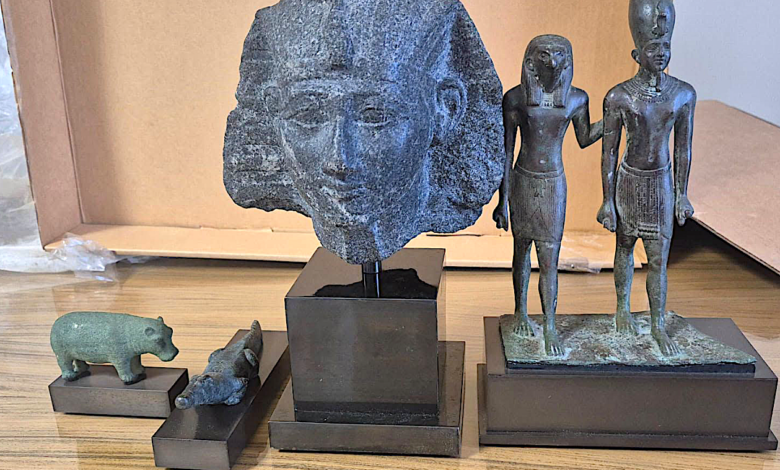
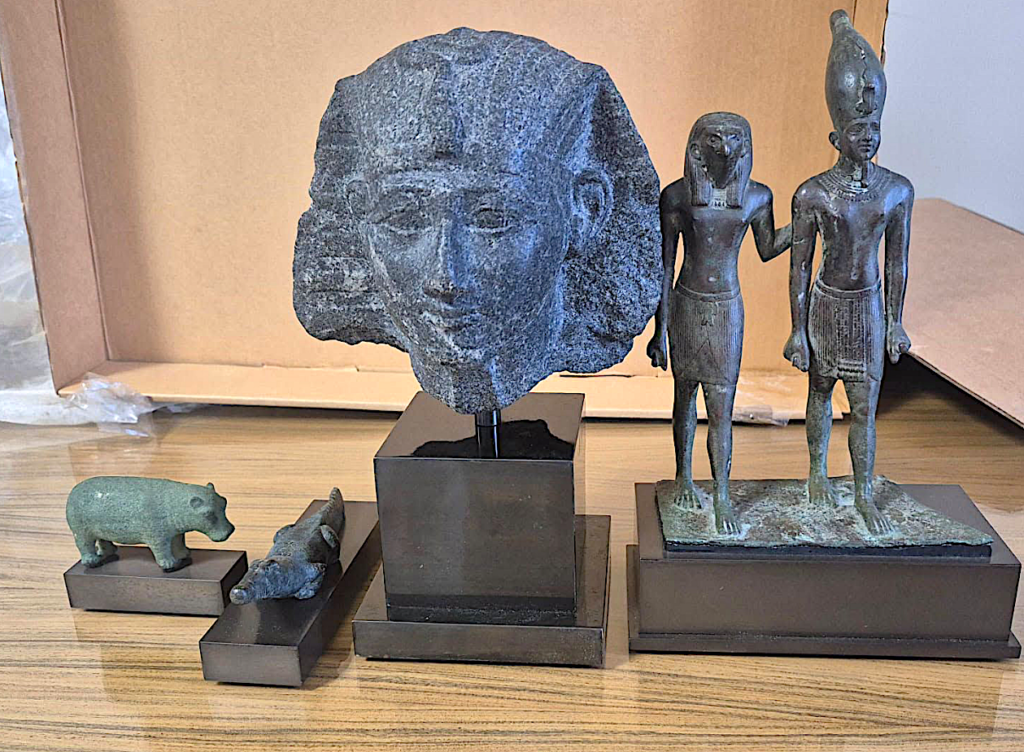
Among the most significant pieces in the recovered group is a granite sphinx head wearing the royal nemes headdress adorned with a uraeus cobra. The sculpture dates to the Eighteenth Dynasty of the New Kingdom and is believed to represent either Queen Hatshepsut or King Thutmose III. Officials described it as one of the most important artifacts among the returned collection because of its artistic and historical value.
The collection also includes a bronze hippopotamus figurine covered with a distinctive green patina. The object dates to the Twelfth Dynasty of the Middle Kingdom and reflects the enduring popularity of hippopotamus imagery in ancient Egyptian art and religious belief.
Another notable piece is a bronze group statue dating to the Twenty-Sixth Dynasty of the Late Period. The sculpture depicts a king wearing the White Crown of Upper Egypt standing beside the falcon-headed god Horus, highlighting the close association between kingship and divine protection in ancient Egyptian ideology.
The fourth artifact is a bronze statue of the crocodile god Sobek. Dating to the Late Period, the figure is shown with its head raised and its body decorated with finely detailed scales, demonstrating the high level of craftsmanship achieved by ancient Egyptian bronze workers.
The latest recovery follows another successful repatriation effort in April, when Egypt secured the return of 13 artifacts from the United States that had also left the country illegally. Those objects included vessels used for storing oils, perfumes, kohl, cosmetics, liquids, and ointments, as well as a statue of the goddess Isis depicted in the form of Aphrodite and a Late Period block statue belonging to a man named Ankh-en-nefer.
Egypt has intensified its efforts in recent years to recover antiquities removed from the country through illicit trafficking. Working with foreign governments, museums, collectors, and legal authorities, the country has succeeded in returning hundreds of artifacts, reinforcing international recognition that cultural heritage belongs within its original historical and cultural context.