An update on the University of Memphis mission
to TT16 (the tomb of Panehsy)
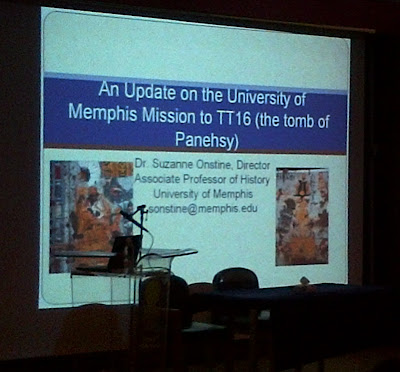
Dr. Suzanne Onstine, Associate Professor of History, University of Memphis
This lecture took place on Sunday 3rd of February at the mummification Museum, Luxor. Attended by 114 persons and took 38 minutes.
Note: The images were displayed are intellectual properties of the University of Memphis Mission and that’s why we have blurred any images that could have been a subject of copy right protection.
The lecturer Dr. Suzanne Onstine for those who doesn’t know her is a superb academic professor according to her students and I am quoting from her students who say “I took Ancient Egyptian History from her and loved the class. She took a subject I already loved and made it even more fun.†“Dr. Onstine changed my life. I saw her on the discovery channel a few years ago, igniting my anthropological career.†“She is always willing to help you.†“I am really grateful to her. She is the first one who made me understand the pre-dynastic period which was very complicated to me.â€
Dr. Onstine describes her approach to history as an interdisciplinary, combining this with her experience in epigraphic field work, passion for Egyptian history especially women’s history and excellent team management skills leads to eminent results and a new prospective in the field.
“The Role of the Chantress (Smyt) in Ancient Egypt†is the title of Dr. Suzanne’s book which was published in 2005 showing her interest in chanters in Ancient Egypt. The book on Amazon click Here
Dr. Suzanne spoke about her work in TT16 at the Mummification Museum in Luxor on a couple of occasions before, in January 2009 and January 2012. Also at Bowers Museum (California) in August 2012 under the title “DEATH ALONG THE NILE: UNCOVERING SECRETS OF EGYPT`S LOST TOMBS†so this time it was an update of the work in the tomb.
The tomb is located at Dra Abu El-Naga. TT16 belonged to the Ramesside period Overseer of Chanters of the Offering Table of Amun and Priest of Amenhotep I, Panehsy and to his wife, a Chantress of Amun named Tarenu.

Phase one of the work is Digital epigraphy started in 2008 to record the tomb before conservation as during the conservation process their might be changes in the tomb like plaster falling off. Also after the conservation there will be an update of the epigraphy to record any changes.
As the second room was damaged badly and not published while the general state of the tomb and the titles of the tomb owners are explored as an introduction to the fieldwork undertaken between 2008 and 2011 was published in JARCE No.47(Pages 231-236)
Phase two is Cleaning and studying the looted human remains.
Many body remains were found in the tomb, mostly dated back to the Third Intermediate Period and badly damaged. As Dr. Suzanne said while displaying a slide shows a disturbing state of the remains were found “In order to sell a small object on the art market, that’s what happen. For some people who would think that’s a small Ushabti for 200 pounds (I don’t know how much they sell for but for whatever) and no one is going to miss it but there are many objects were destroyed for it.â€
Even though the state of the human remains was found but still we could get so much information of them. Displaying a slide with an image of a head was found and still has the tongue even after about 3000 years.

One of the remains found has a stick up the spine to straighten it and Dr. Suzanne suggests that it might be a way to make the deceased look more powerful during the journey to the afterlife with Anubis.
As there are about 20-30 meters to clean so maybe 19thDynasty remains would be found although the burial shaft had been looted already.
There are coffin parts and textiles were found too dated to TIP (Third Intermediate Period)
Regarding the future work on the human remains, Dr. Suzanne said “Maybe give them their names back and the proper burial they would have had 3000 years ago. Scientifically make sense to their lives.†Which shows more of a genuine approach to the excavation full of respect to their past. It is like saying in simple words “We are not here just to dig for any academic or personal glory and achievement but more importantly to help to make the Ancient Egyptians lives complete according to their believes and let them rest in peace respectfully.â€
The Iconography in the tomb
Hathor “Mistress of the west coming out of the mountainâ€
Mut as a tree goddess pouring offerings of cool water for the deceased
First: Hathor emerges from the mountain
Papyrus motif recalls her role as a guardian of Horus in the marsh and there is another one in the second room.
Second: Nut and the sycamore tree

Nut is protective (Sun god passes through her) and she is regenerative as a mother goddess
– Book of the Dead spell 59 associates her with cool water which she pours out for the deceased.

– Maybe associated with water because sycamores need a lot of water, artificial gardens or pools. Also there are two of them, No idea why
Although later in the lecture Dr. Suzanne proposed that maybe there were 2 different artists. The proposal supported by two different styles, examples in depictions of the ears and fingers.

The work is still ongoing to continue cleaning and documenting the tomb. Digital epigraphy will continue and then the conservation would take place as Dr. Suzanne referred to the previous lecture by Dr. Violeta Pereyra and the laser cleaning technique which she thinks that could be a possible option for TT16.

If you would like to contribute to this project, tax-deductable donations can be made through the University of Memphis. For details, please email Dr. Suzanne Onstine on sonstine@memphis.edu
Also you could read Dr. Suzanne Onstine’s article about the time of the uprising in Egypt titled “Excavation and Revolution†published in History Happenings (A newsletter published by the Department of History, the University of Memphis) April 2011. Click Here