
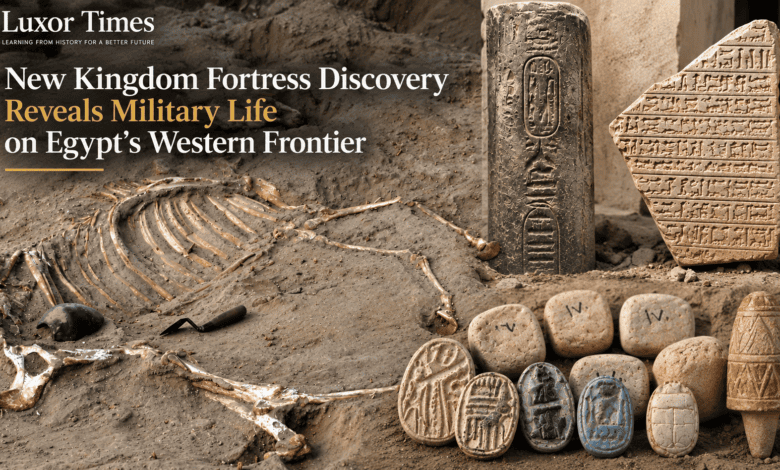
Egyptian archaeological mission uncovers residential complex, grain stores, ovens, an intentionally buried horse and, for the first time in Beheira excavations, part of a hieratic inscription belonging to King Merneptah.
An Egyptian archaeological mission working at Tell el-Abqain in Beheira Governorate has uncovered a significant collection of structures and artifacts that shed new light on military organization, daily life and urban planning within one of ancient Egypt’s New Kingdom fortresses.
The discoveries reinforce the strategic importance of Tell el-Abqain as part of a network of military fortifications established along the western approaches to the Nile Delta during the New Kingdom to protect Egypt’s borders from attacks by Libyan groups.
Minister of Tourism and Antiquities Sherif Fathy said the discovery adds a new dimension to the understanding of the military fortification system established by the ancient Egyptians to defend the country’s borders.
He noted that the residential structures, storage facilities and diverse artifacts uncovered by the mission provide evidence extending beyond the fortress’s military function, offering insights into the daily, economic and religious lives of the people who lived within it.
The minister also praised the work of Egyptian archaeological missions and emphasized the ministry’s continued support for excavation, scientific research, conservation, study and documentation at archaeological sites across Egypt.


Planned Streets, Houses and Food Production
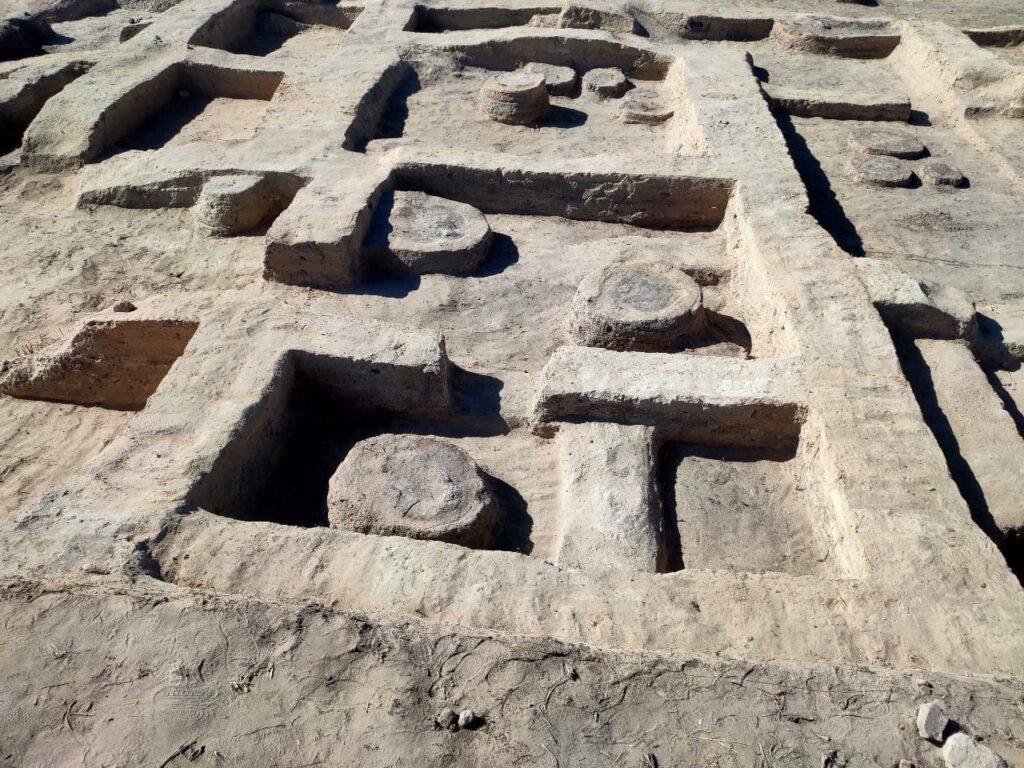
Dr. Hisham El-Leithy, Secretary-General of the Supreme Council of Antiquities, said excavations revealed a large mudbrick residential complex.
On its northern side, archaeologists uncovered a main street approximately four meters wide running from east to west. It intersects with another street extending from south to north, while its principal entrance connects with the southern entrance of the fortress, which was constructed from limestone.
According to El-Leithy, this layout demonstrates careful urban and architectural planning within the fortress.
The residential complex was divided into several rooms containing grain silos and cylindrical pottery ovens used for preparing food and baking grain. Together, the installations point to an organized system for supplying the fortress’s inhabitants and managing essential resources.
Archaeologists also uncovered residential rooms near the well area in the southeastern corner of the fortress. Three stone wells bearing inscriptions with the titles of King Ramesses II had previously been discovered there.
The location of these rooms close to the wells suggests that this part of the fortress contained a residential community closely connected with water supplies and everyday activities.
Charred Wheat Preserved Inside Storage Jars
Mohamed Abdel Badie, Head of the Egyptian Antiquities Sector, said some of the newly discovered rooms, particularly those north of the main street, had been used to store wheat.
Large pottery vessels discovered inside the rooms still contained charred wheat grains.
The discovery provides direct archaeological evidence for food storage and resource management within the fortress, helping researchers reconstruct aspects of its economy and the daily lives of its inhabitants.
Young Horse Given an Intentional Burial
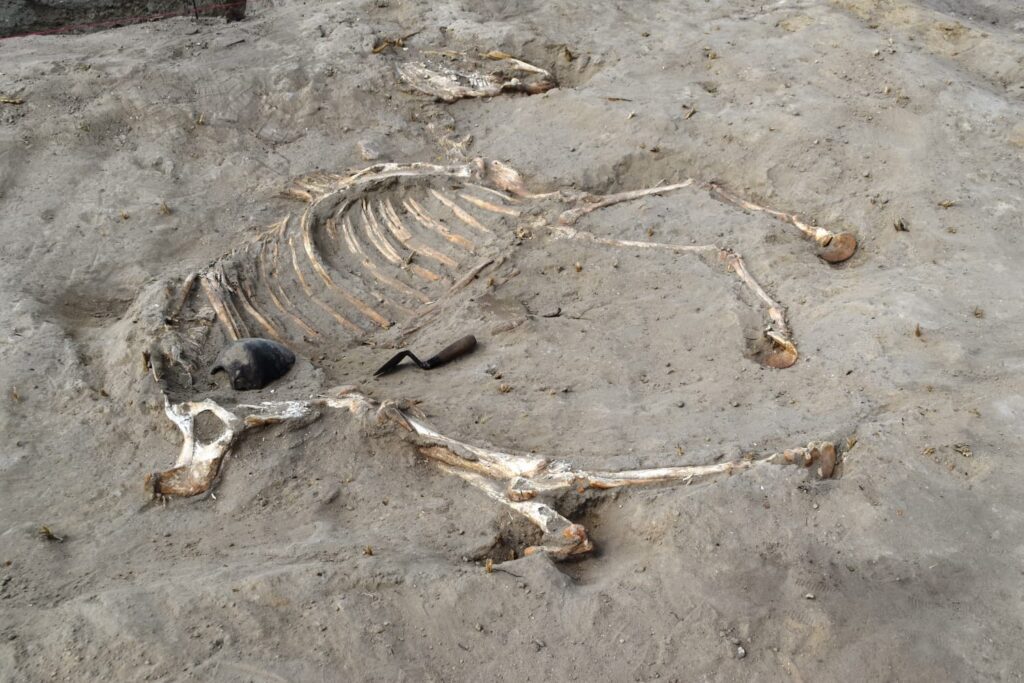
Among the most striking discoveries is the complete burial of a young male horse.
Preliminary studies indicate that the animal belonged to a medium-sized type characterized by agility and speed. Archaeologists suggest that horses of this type could have been used for training, military activities or pulling chariots during the New Kingdom.
The horse’s complete skeletal position, the orientation of its head and the orderly nature of the burial indicate that it was deliberately buried rather than discarded.
Archaeologists therefore suggest that it may represent an intentional or commemorative burial.
Only a few meters from the room containing the horse, the mission discovered cylindrical pieces made from alabaster and limestone. These are thought to have formed part of the decorative fittings of a chariot horse harness.
The combination of the horse burial and possible chariot equipment provides further evidence for the military character of the site and the use of horses and chariots by those stationed there.
First Hieratic Inscription of Merneptah Found in Beheira Excavations
Khaled Abdel Ghani Farahat, Director General of Beheira Antiquities and supervisor of the excavations, announced another particularly significant discovery.
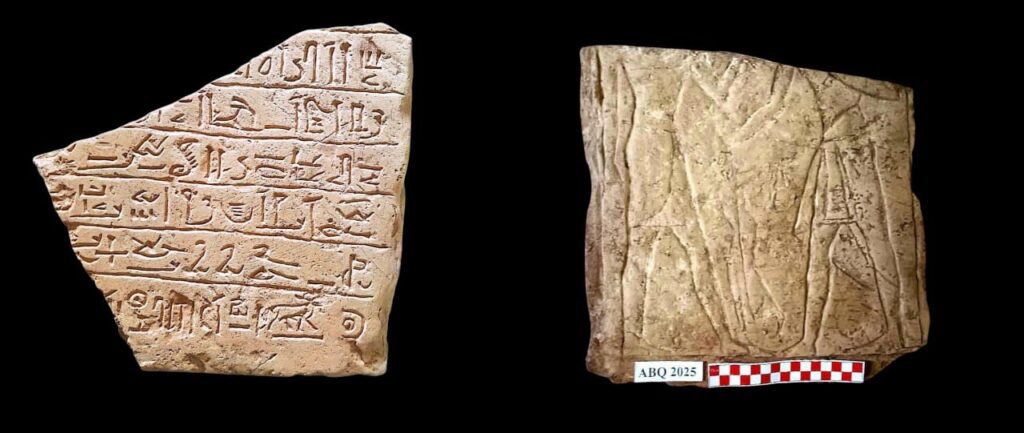
For the first time in the history of archaeological excavations conducted by the Beheira Antiquities Area, the mission uncovered part of a limestone stela preserving traces of a hieratic text associated with King Merneptah.
The surviving text describes the king’s strength and compares it with the power of the god Seth. It also contains a reference to the creator god Ptah.
The discovery is particularly important because it provides new textual evidence connected with royal authority and religious ideology at the fortress during the New Kingdom.
Ramesses II and a Depiction of a Libyan Captive
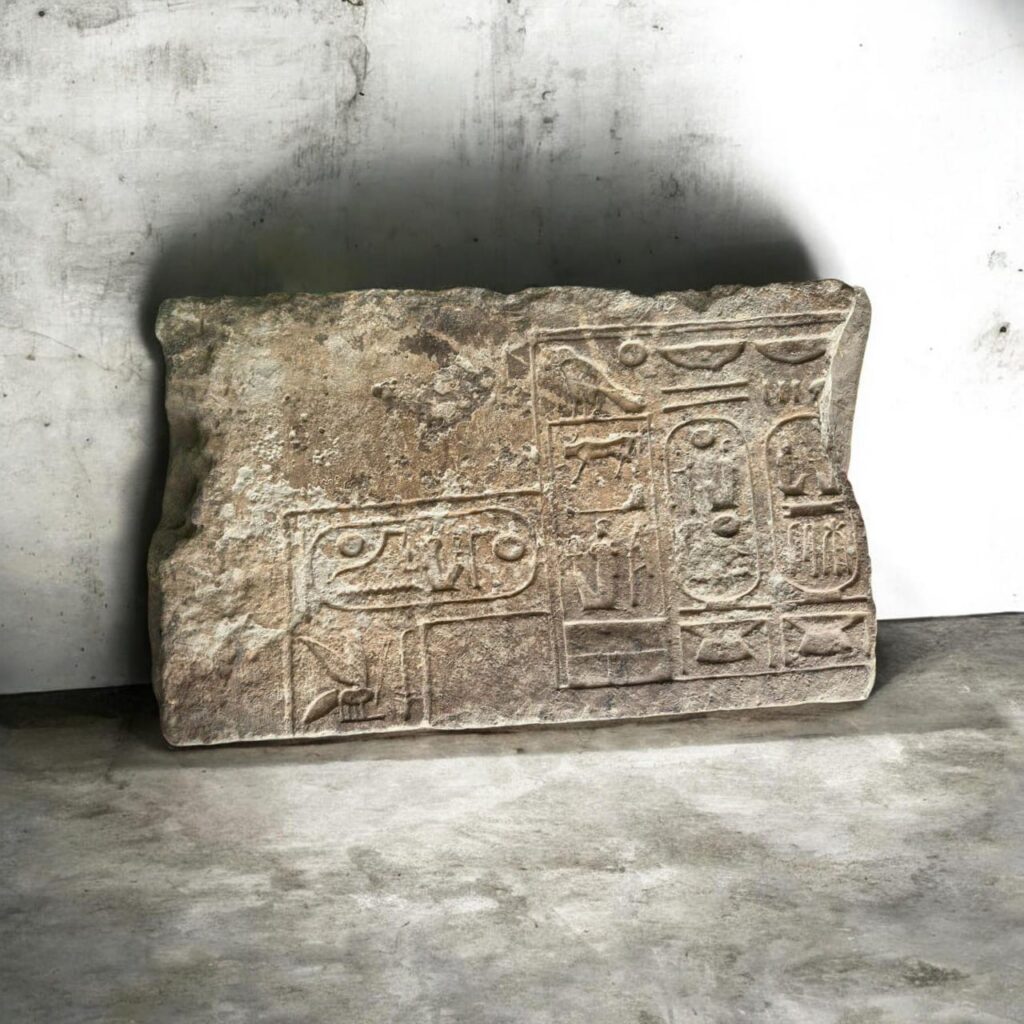
The mission also discovered remains of a limestone stela bearing a hieroglyphic inscription containing the birth name, throne name and Horus name of King Ramesses II.
Another stela preserves a scene depicting a captive with his body bent in submission and his hands bound.
According to the archaeological mission, the captive’s clothing identifies him as a Libyan prisoner associated with the Meshwesh.
The discovery provides another important indication of the fortress’s military role on Egypt’s western frontier and its relationship with the populations living beyond the Delta.
Scarabs and Amulets Reveal Religious Life Inside the Fortress
A collection of scarabs discovered during the excavations is providing further evidence for the religious identities and practices of the fortress’s inhabitants.
Some bear the names of Ramesses II and Seti I, while others contain the names and titles of deities including Amun, Sekhmet, Ptah and Seth.
Their presence indicates the role these gods played in the everyday religious lives of those living inside the fortress and the ways in which inhabitants sought divine protection.
Archaeologists also uncovered religious amulets associated with concepts including protection, fertility, regeneration and strength.
Among them are amulets in the forms of a fish, lotus flower, cobra, the “nefer” sign and a baboon.
Together, the objects illustrate the importance of personal religious belief within a community whose members combined military responsibilities with ordinary domestic and social life.
Everyday Life Behind the Fortress Walls
The archaeological finds extend well beyond weapons, royal inscriptions and evidence of military activity.
The mission recovered a wide range of pottery vessels and sherds used for storing, cooking and serving food, as well as containers associated with perfumes and oils.
Among the finds is a flask connected with pilgrimage to Abydos.
Other objects document everyday economic and domestic activities, including loom weights used in textile production, fragments of grinding stones and querns, and weights used with balances.
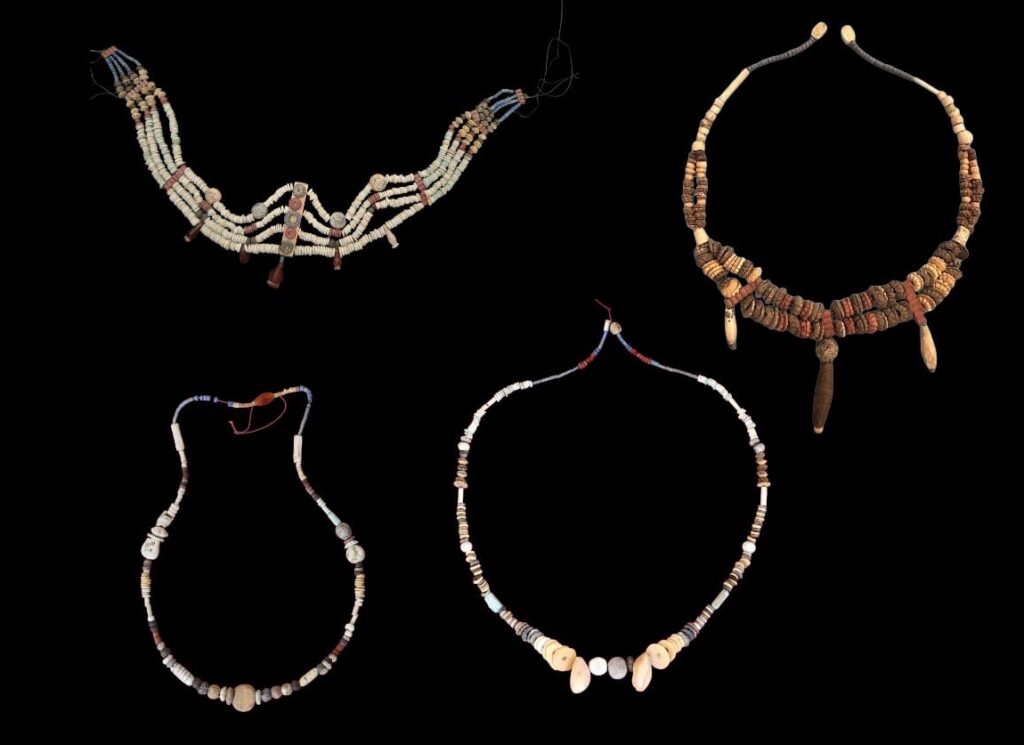
Personal ornaments and jewelry were also discovered, providing additional evidence for the social life and aesthetic preferences of the fortress’s inhabitants.
Taken together, the discoveries are beginning to reveal Tell el-Abqain not simply as a military installation, but as a living community.
Soldiers and other inhabitants stored and prepared food, maintained water supplies, produced textiles, practiced religious rituals, used personal ornaments and carried out the ordinary activities of daily life within the protection of the fortress walls.
Defending Egypt’s Western Frontier
The discoveries at Tell el-Abqain are helping archaeologists reconstruct a more detailed picture of Egypt’s defensive organization along the western Delta during the New Kingdom.
The evidence of carefully planned streets, residential quarters, grain storage, food preparation, water infrastructure, horses and possible chariot equipment, together with royal inscriptions and depictions connected with Libyan populations, demonstrates the multiple functions of the fortress.
Rather than operating solely as a defensive outpost, Tell el-Abqain appears to have supported a permanent community whose military, economic, domestic and religious activities were closely interconnected.
The Egyptian archaeological mission is continuing excavation, documentation and study at the site in the hope of uncovering further elements of the fortress and developing a more complete understanding of Tell el-Abqain’s role within the system that protected Egypt’s western borders during the New Kingdom.
#Archaeology #Egyptology #Egypt #AncientEgypt