
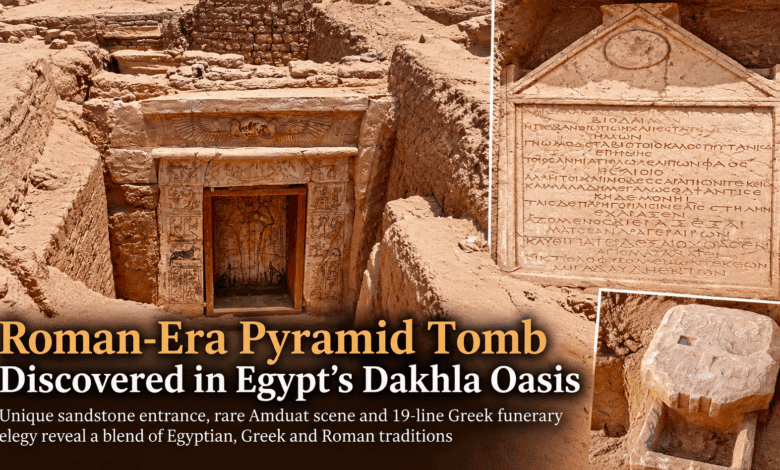
Egyptian archaeologists uncover a mud-brick pyramid tomb at Bir el-Shaghala with a unique sandstone entrance, an Amduat scene and a 19-line funerary elegy written in ancient Greek
An Egyptian archaeological mission has uncovered a Roman-period pyramid-shaped tomb at the Bir el-Shaghala archaeological site in Dakhla Oasis, Egypt’s New Valley Governorate.
The mud-brick tomb, which was built for a man and his wife, features an unusual sandstone entrance decorated with Egyptian funerary imagery and hieroglyphic inscriptions. Among its most significant features is a scene representing the seventh hour of the Amduat, one of ancient Egypt’s major funerary compositions describing the nocturnal journey of the sun god through the underworld.
The excavation also revealed a stone funerary stela carrying a 19-line elegy written in ancient Greek, together with a sandstone offering table and purification basin, pottery vessels and a bronze coin bearing the image of the Roman emperor Constantine.
The discovery was made by an Egyptian mission from the Supreme Council of Antiquities working at Bir el-Shaghala.
Minister of Tourism and Antiquities Sherif Fathy said the discovery reflects the archaeological and cultural richness of Egypt’s oases and provides further evidence for the succession and interaction of cultures that developed in Egypt over different historical periods.


He added that the ministry continues to support Egyptian archaeological missions and their work to expand knowledge of Egypt’s history across different periods.
A Monumental Sandstone Entrance
According to Mohamed Abdel Badie, Head of the Egyptian Antiquities Sector at the Supreme Council of Antiquities, access to the tomb begins with a staircase of 14 steps leading to its main entrance.
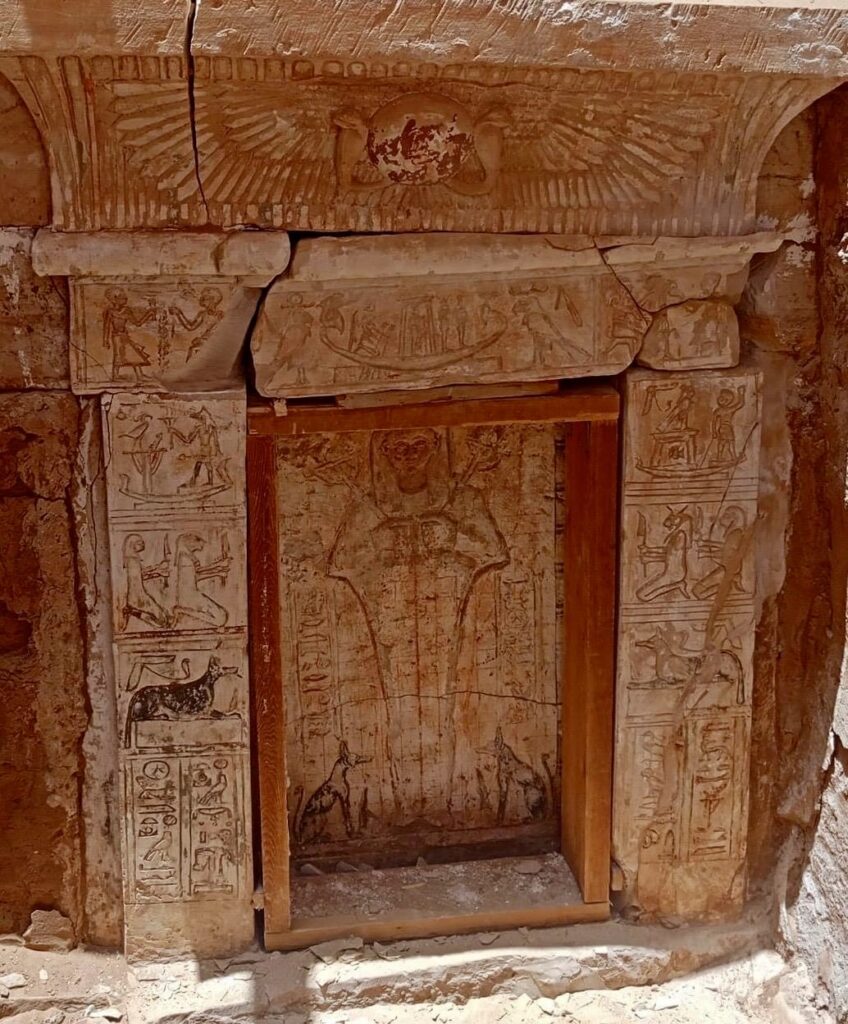
The entrance is constructed from sandstone in an Egyptian architectural style and decorated with incised hieroglyphic inscriptions containing funerary spells and recitations intended to provide protection for the deceased.
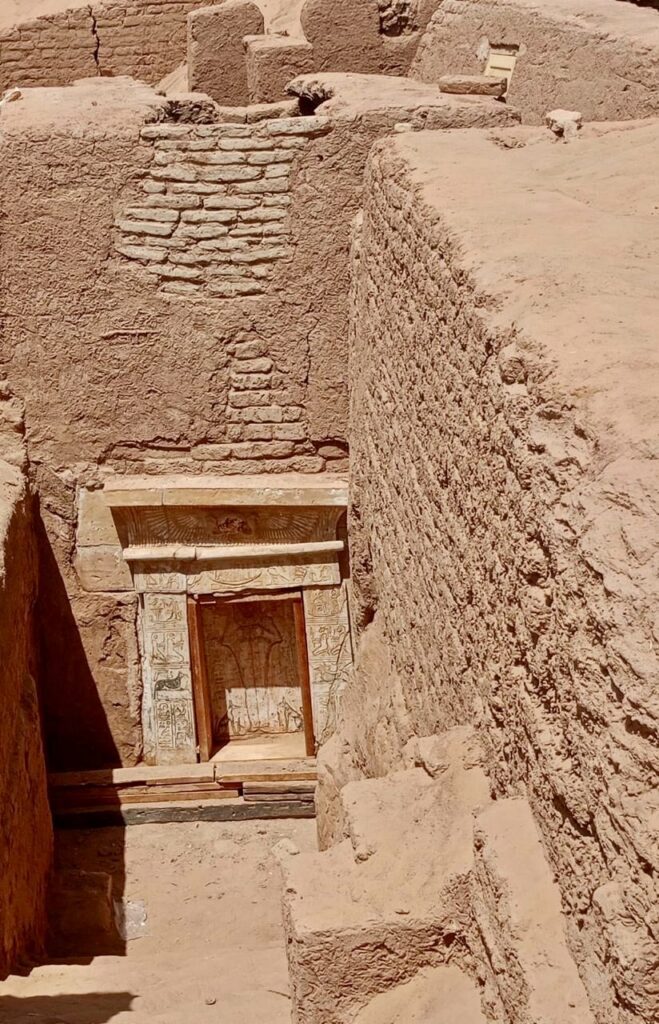
Its design is particularly distinctive within the Bir el-Shaghala necropolis.
An Egyptian cornice crowns the entrance and is decorated with a winged sun disk flanked by two cobras. Below it is an architectural element resembling a bundle of reeds.
The upper lintel carries one of the most important elements discovered in the tomb: a funerary scene representing the seventh hour of the Amduat.
According to the archaeological mission, this particular scene has not previously been identified in the tombs excavated at the necropolis.
The Amduat, whose name can be translated as “That Which Is in the Underworld”, describes the sun god’s journey through the 12 hours of the night and his regeneration at sunrise. Its appearance at Bir el-Shaghala demonstrates the continued use and adaptation of much older Egyptian funerary traditions during the Roman period.
Additional inscriptions and scenes associated with the tomb’s owners extend along the sides of the entrance.
Archaeologists found the doorway sealed by a stone blocking slab decorated with an Osirian figure surrounded by funerary spells.
Inside the Pyramid Tomb
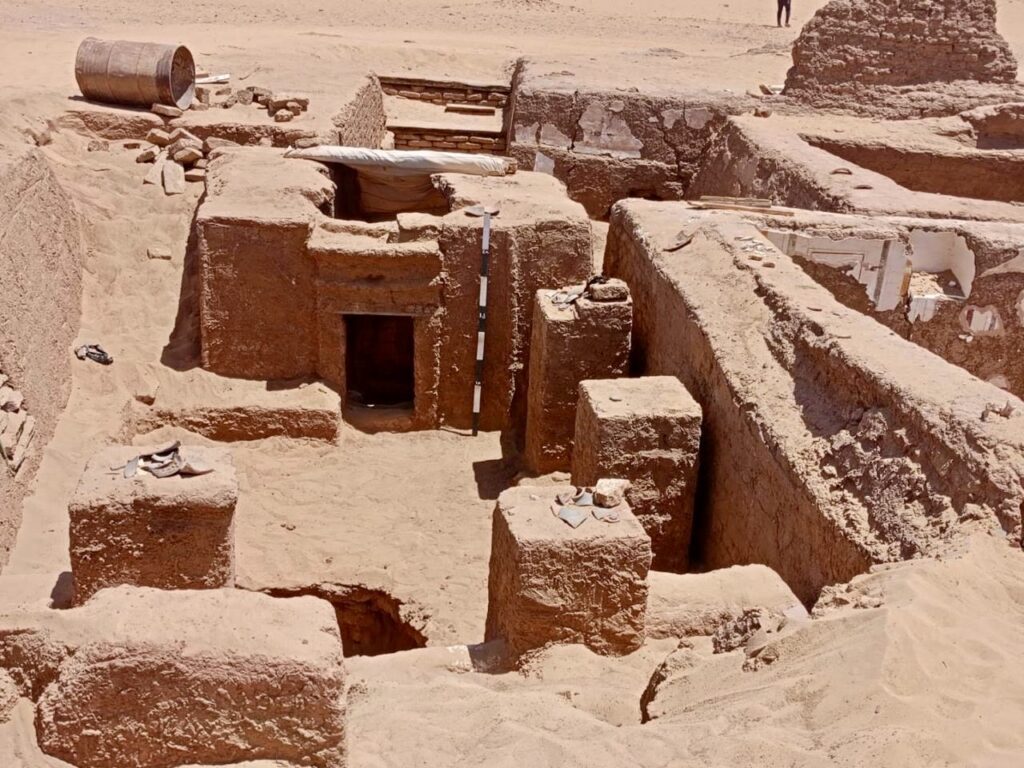
Beyond the entrance lies a transverse mud-brick hall with a vaulted ceiling, part of which has collapsed on its western side.
Two mud-brick burial chambers are located to the right of the hall. Both were covered with a layer of plaster, while the pyramid-shaped superstructure of the monument rises above them.
This type of architecture is already known at Bir el-Shaghala.
Previous archaeological research at the site has documented elaborate Roman-period tombs combining underground or ground-level burial spaces with vaulted chambers, funerary chapels and pyramid-shaped superstructures. Published studies have also demonstrated the persistence of traditional Egyptian religious imagery and Osirian funerary concepts within these monuments during Roman rule.
A 19-Line Greek Funerary Poem
One of the most remarkable discoveries came from the southern wall of the pyramid superstructure.
Archaeologists uncovered a rectangular stone funerary stela terminating in a triangular pediment. At its centre is a sun disk carved in relief.
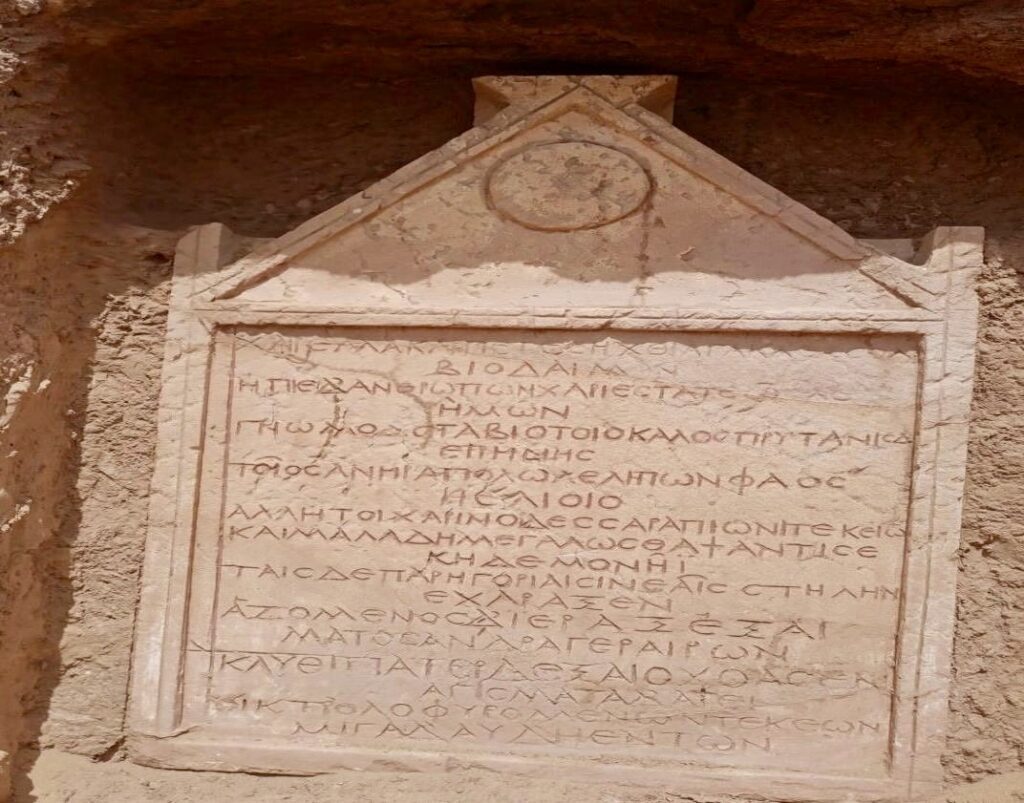
The stela carries a funerary elegy written in ancient Greek using red ink.
The inscription consists of 19 lines and commemorates a man named “Pesikhtis”.
Preliminary study of the inscription suggests that Pesikhtis may have held the position of a judge.
The elegy has provisionally been dated to the late third or early fourth century AD.
Beyond identifying the deceased, the inscription provides evidence for the literary and cultural environment of Dakhla Oasis during the Roman period. Its presence alongside Egyptian funerary architecture, hieroglyphic inscriptions and imagery derived from the Amduat is particularly significant, demonstrating the coexistence of Egyptian and Greek cultural traditions within the same funerary monument.
Hisham El-Leithy, Secretary-General of the Supreme Council of Antiquities, said the combination of architecture, inscriptions and funerary texts provides important information about religious practices and cultural life in Dakhla Oasis during the Roman period.
Offerings, Pottery and a Coin of Constantine
The excavation produced further objects associated with the tomb and its use.
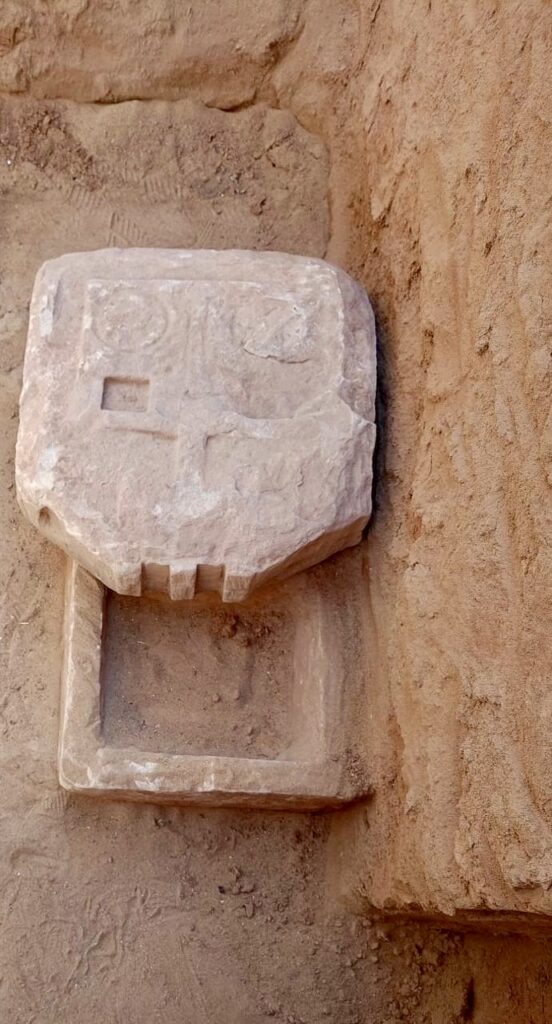
According to Mohamed Ibrahim, Director General of New Valley Antiquities, archaeologists discovered a sandstone offering table positioned above a purification basin made from the same material.
A collection of pottery vessels was also recovered.
Among the finds was a bronze coin bearing a relief image of the Roman emperor Constantine.
The archaeological evidence suggests that the monument may have been reused during a later phase.
At the upper level of the tomb, excavators uncovered a mud-brick chapel constructed above the main entrance. In front of it was a funerary shrine containing four square mud-brick columns.
These additions indicate that the monument may have undergone architectural changes as its funerary and commemorative functions developed over time.
Bir el-Shaghala and the Necropolis of Ancient Mut
Bir el-Shaghala is one of the most important archaeological sites in Dakhla Oasis and formed part of the cemeteries associated with Mut, known in antiquity as Mothis, which served as the oasis capital during the Ptolemaic and Roman periods.
The site’s modern name derives from a local water well known as Bir el-Shaghala.
Excavations by the Supreme Council of Antiquities began at the site in 2002 and have revealed a series of tombs displaying considerable variation in their architectural plans and decoration.
Published archaeological research has established Bir el-Shaghala as an important source for understanding elite funerary architecture in Roman-period Dakhla.
One previously studied monument consists of a multi-level funerary complex with vaulted burial chambers and a pyramid superstructure. Another, Tomb 5, belonged to Petophis, or Padiwepwaut, an elite inhabitant of ancient Mothis and included a pyramid chamber and extensive decoration associated with Osirian funerary traditions.
The tombs demonstrate how communities in Dakhla continued to draw upon Egyptian funerary beliefs centuries after Egypt had become part of the Roman Empire.
Egyptian Traditions in Roman Dakhla
The newly discovered tomb adds another important example to this archaeological landscape.
Several tombs at Bir el-Shaghala combine open courts or stairways, burial chambers, vaulted ceilings, funerary chapels and pyramid-shaped superstructures. Sandstone and locally produced mud brick were both employed in their construction.
Their decoration frequently drew upon Egyptian concepts of death, resurrection and the afterlife, particularly traditions associated with Osiris.
At the same time, Greek and Roman elements appear alongside these Egyptian traditions.
The newly discovered tomb provides an especially striking example of this cultural environment. Within a single funerary complex, archaeologists have now documented hieroglyphic funerary texts, Egyptian religious imagery, a scene from the Amduat, an Osirian representation, a Greek funerary poem and material evidence belonging to the Roman imperial period.
Rather than representing the replacement of one cultural tradition by another, the monument offers evidence for the complex ways in which the inhabitants of ancient Mothis maintained and adapted Egyptian funerary beliefs while participating in the wider cultural world of Roman Egypt.
The discovery also adds to a growing archaeological record from Bir el-Shaghala showing that the necropolis was used for substantial and carefully decorated funerary monuments, several of which appear to have belonged to prominent members of the local community.
Excavations at the site continue to provide new evidence for the architecture, religious beliefs and cultural life of the inhabitants of Dakhla Oasis during the centuries of Ptolemaic and Roman rule.